




menu

Tank vs. Tankless Water Heaters in Los Angeles – Expert Guidance for Hard Water Conditions and Energy Efficiency

Get straight answers on storage versus instantaneous water heaters designed for Los Angeles's hard water challenges, helping you choose the right system for your home's efficiency and longevity.

Slider Image 1
Slider Image 2
Slider Image 3
Slider Image 4
Slider Image 5
Slider Image 7
Slider Image 8
Slider Image 9
Slider Image 10
Slider Image 11

Why the Tank vs. Tankless Decision Matters More in Los Angeles

Los Angeles water sits at the harder end of the spectrum, with dissolved minerals like calcium and magnesium averaging 250 to 350 parts per million across the metro. This mineral load creates distinct challenges for both traditional and on-demand water heaters.

Conventional tankless water heaters excel in some areas but struggle with scale buildup when you skip descaling maintenance. The heat exchanger's narrow pathways corrode faster in hard water conditions, reducing flow rates and eventually causing complete failure. A storage tank system accumulates sediment at the bottom, which you can flush annually, but the anode rod corrodes faster in mineral-heavy water, shortening tank life.

Your choice between standard and tankless water heaters depends on household size, simultaneous use patterns, and whether you have a water softener. A family of four in Silverlake running two showers and a dishwasher simultaneously needs a tankless unit with a minimum flow rate of 8 gallons per minute, or you experience temperature fluctuations. A couple in Echo Park with sequential usage patterns might benefit more from a 40-gallon storage tank that costs half as much upfront.

The city's Uniform Plumbing Code requires earthquake strapping for tank installations, and gas tankless units need specific venting configurations that do not work in older homes without modification. These local requirements shift the cost comparison between conventional versus tankless water heaters beyond simple equipment pricing.

Understanding how Los Angeles's infrastructure and water quality affect each system helps you avoid expensive mistakes. The wrong choice leads to premature failure, inconsistent hot water, or retrofitting costs that exceed the initial savings.

Why the Tank vs. Tankless Decision Matters More in Los Angeles
How Each System Performs in Real Los Angeles Conditions

How Each System Performs in Real Los Angeles Conditions

Storage water heaters maintain a reserve of heated water in an insulated tank. The burner or heating element cycles on when temperature drops below setpoint, creating standby heat loss. In Los Angeles's mild climate, this standby loss averages 10 to 20 percent of total energy use, less than in colder regions where ambient garage temperatures drop further.

The tank's sacrificial anode rod attracts corrosive minerals, protecting the steel liner. Hard water consumes this rod faster, requiring inspection every two years instead of the typical three to four. When the anode depletes completely, the tank itself corrodes, leading to leaks. Most tanks last eight to twelve years in Los Angeles without water softening, compared to fifteen years with treated water.

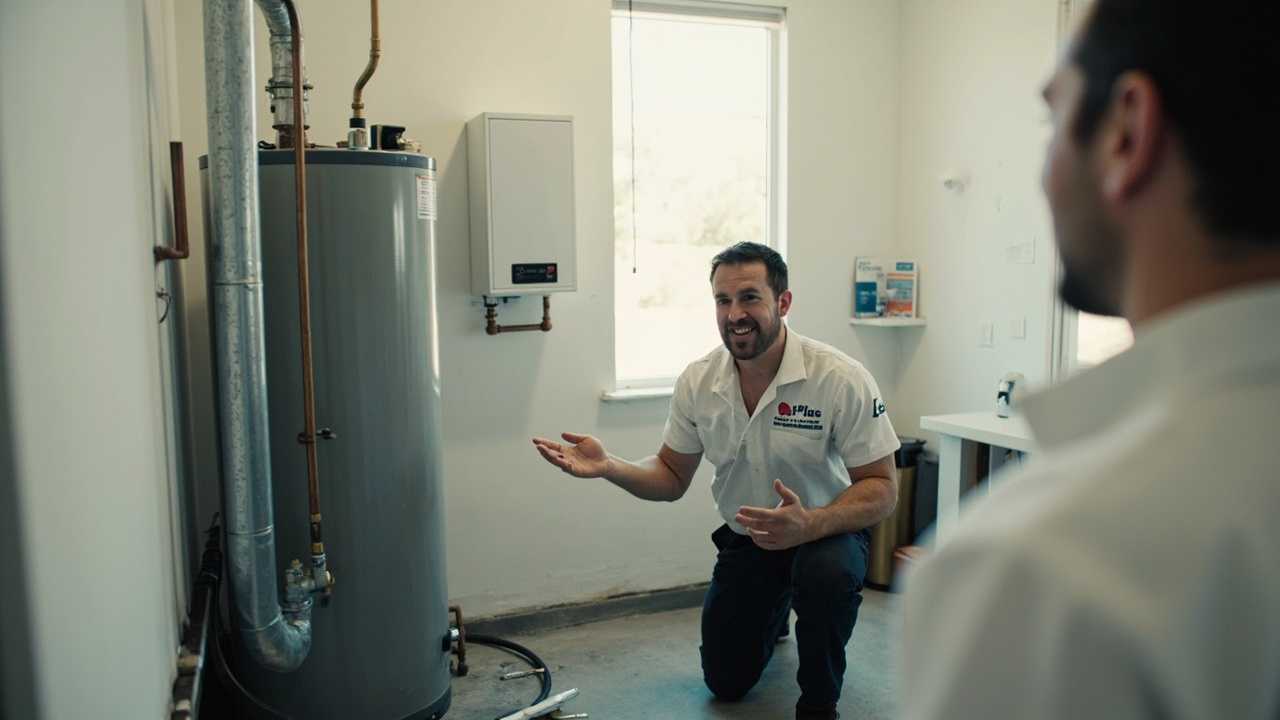
Instantaneous water heaters activate only when you open a hot water tap, eliminating standby loss. The heat exchanger rapidly heats water as it flows through, providing endless hot water as long as you stay within the unit's flow capacity. The problem surfaces when multiple fixtures demand hot water simultaneously. A standard shower uses 2.5 gallons per minute, a bathroom faucet uses 1 gallon per minute, and a dishwasher uses 1.5 gallons per minute. That scenario requires a 5-gallon-per-minute capacity minimum, and the unit must also raise incoming water temperature by 70 degrees in winter months.

Los Angeles's incoming water temperature ranges from 55 degrees in January to 75 degrees in August. This seasonal swing affects tankless performance more than tank systems. The same unit delivers 8 gallons per minute in summer but only 5 gallons per minute in winter, creating inconsistency.

Gas tankless units require larger gas lines than most homes have, necessitating a line upgrade from half-inch to three-quarter-inch diameter. Electric tankless units draw 120 to 150 amps, requiring a panel upgrade in homes with 100-amp service.

How to Evaluate Which System Fits Your Home

Tank vs. Tankless Water Heaters in Los Angeles – Expert Guidance for Hard Water Conditions and Energy Efficiency
01

Calculate Peak Demand

List every hot water fixture you might use simultaneously during your busiest morning or evening routine. Assign flow rates to each fixture. Add them together to determine your peak gallons-per-minute demand. Compare this number to both your current system's capacity and potential replacement options. Most Los Angeles households peak between 4 and 7 gallons per minute. This calculation determines whether an instantaneous system can actually meet your needs.
02

Assess Infrastructure Requirements

Check your gas line diameter, electrical panel capacity, and venting configuration. Tankless gas units need dedicated venting to the exterior, often requiring new penetrations through exterior walls or roof structures. Electric tankless systems need dedicated 240-volt circuits with substantial amperage. Storage tanks need earthquake strapping, drain pan installation, and adequate clearance for maintenance access. Understanding these requirements prevents surprise costs during installation and helps you budget accurately for the complete project.
03

Compare Total Ownership Cost

Add equipment cost, installation cost, maintenance requirements, energy costs, and expected lifespan. A tankless unit costs more upfront but uses less energy. A storage tank costs less initially but requires more frequent replacement. Annual descaling for tankless systems costs money. Anode rod replacement for tanks costs money. Factor in your water hardness, usage patterns, and how long you plan to stay in your home. This complete picture reveals which option delivers better value for your specific situation.

Why Local Expertise Changes the Tank vs. Tankless Equation

Generic online comparisons miss critical factors specific to Los Angeles installations. The city's building codes require earthquake strapping configurations that vary by structure type. Single-family homes in hillside areas like Mount Washington face different requirements than multi-unit buildings in Koreatown. A Plus Plumbing Los Angeles understands these distinctions because we navigate them daily.

We know which tankless models handle local water hardness without constant maintenance headaches. We know which storage tank brands use better anode rod materials that last longer in mineral-heavy water. We know when a water softener installation shifts the cost analysis enough to change your decision. This knowledge comes from installing both system types across every Los Angeles neighborhood for years.

The Metropolitan Water District sources from the Colorado River and State Water Project, each with different mineral profiles. Your water hardness varies by neighborhood based on which source dominates your local supply. Areas east of downtown receive harder Colorado River water. Westside neighborhoods get slightly softer State Water Project supply. We account for these differences when recommending system types and maintenance schedules.

Building codes require specific clearances, venting materials, and seismic restraints. An inspection failure delays your project and costs you money. We pull permits correctly the first time and schedule inspections that pass without callbacks. Our familiarity with Los Angeles inspectors and their interpretation of code requirements prevents the frustrating delays that happen when contractors from outside the area tackle local jobs.

Gas tankless installations require combustion air calculations based on your home's construction type and room volume. Getting this wrong creates carbon monoxide risks. We perform these calculations according to California's strict Title 24 energy code requirements, ensuring both safety and efficiency.

What You Need to Know Before Choosing Your System

Installation Timeline and Coordination

Tank replacement typically takes four to six hours when existing connections and venting work with the new unit. Tankless installations require eight to twelve hours because of gas line upgrades, electrical modifications, or new venting penetrations. Complex installations in older homes with outdated infrastructure can extend to two days. We schedule permit inspections in advance to prevent delays. Most projects start within three to five business days of approval. Emergency replacements for failed units receive priority scheduling, often beginning same-day or next-day when you have no hot water.

Proper System Sizing and Assessment

We calculate your actual hot water demand based on fixture count, occupancy, and usage patterns. A four-person household needs different capacity than a two-person household, even in identical homes. We measure incoming water temperature, test water hardness, and evaluate your existing gas pressure or electrical capacity. For tankless systems, we verify that your gas meter can supply the increased demand. For storage tanks, we determine optimal tank size to minimize standby loss while meeting peak demand. This assessment prevents undersized systems that frustrate you and oversized systems that waste energy and money.

Performance and Reliability Outcomes

A properly installed system delivers consistent hot water at your desired temperature without fluctuation. Tank systems provide immediate hot water at full flow rate. Tankless systems provide endless hot water within their flow capacity. You should never experience temperature drops mid-shower or run out of hot water during normal use. Energy bills should decrease with tankless systems or stay consistent with efficient tank systems. The unit should operate quietly without banging, whistling, or rumbling sounds. Any performance issues within the first year indicate installation problems, not equipment defects, and require immediate correction.

Maintenance Requirements and Longevity

Tankless systems need annual descaling in Los Angeles to prevent scale buildup from reducing performance. This service takes about an hour and extends unit life significantly. Tank systems need annual flushing to remove sediment and anode rod inspection every two years. With proper maintenance, tankless units last fifteen to twenty years. Tank systems last eight to twelve years in hard water conditions, fifteen years with water softening. We provide maintenance reminders and schedule annual service visits. Regular maintenance prevents emergency failures and maximizes your return on investment.

Frequently Asked Questions

You Have Questions,
We Have Answers

Is it better to have a tank or tankless water heater? +

It depends on your household needs and budget. Tank water heaters store 40 to 80 gallons and cost less upfront, making them ideal for families with high simultaneous demand. Tankless units heat water on demand, never run out, and save space in smaller Los Angeles homes. They cost more initially but reduce energy bills over time. If you have multiple bathrooms and need hot water for showers, laundry, and dishes at once, a tank may work better. If you want efficiency and space savings, tankless is the smarter choice for most Los Angeles residents.

What is the downside of a tankless water heater? +

The main downside is upfront cost. Tankless water heaters cost two to three times more than tank units, including installation and potential electrical or gas line upgrades. In older Los Angeles homes, retrofitting can add expense. Tankless units also have flow rate limits. If multiple fixtures run simultaneously, like two showers and a dishwasher, the unit may struggle to maintain temperature. Hard water in some Los Angeles neighborhoods can cause mineral buildup, requiring annual descaling. Lastly, gas tankless models need proper venting, which may require structural modifications in tighter spaces.

Why do plumbers not recommend tankless water heaters? +

Some plumbers hesitate to recommend tankless units because of installation complexity and higher service costs. Retrofitting older Los Angeles homes often requires upgrading gas lines, electrical panels, or venting systems, which increases labor time and homeowner expense. Tankless units also require annual maintenance to prevent mineral buildup from hard water, common in parts of Los Angeles. Many plumbers earn more from tank water heater replacements due to simpler installations. However, experienced plumbers who specialize in tankless systems recognize their long-term value and efficiency, especially for homeowners prioritizing energy savings and space.

Are tank water heaters being phased out? +

No, tank water heaters are not being phased out. They remain widely available and code-compliant in Los Angeles. However, California energy efficiency regulations are tightening. New standards require higher efficiency ratings, which some older tank models do not meet. This pushes manufacturers toward heat pump water heaters and condensing tank models. While tankless and hybrid systems gain popularity, traditional tank heaters still dominate the market due to lower cost and easier installation. Homeowners in Los Angeles can still choose tank models, but expect future regulations to favor more efficient technologies over time.

Can I take a long shower with a tankless water heater? +

Yes, you can take long showers with a tankless water heater. Unlike tank models that run out of hot water after 40 to 80 gallons, tankless units heat water continuously. As long as the flow rate stays within the unit's capacity, hot water is unlimited. However, simultaneous use matters. If someone showers while running the dishwasher and washing machine, the tankless unit may struggle to maintain temperature. For Los Angeles households with high demand, sizing the unit correctly is critical. A properly sized tankless system handles long showers without issue.

What water heater do plumbers recommend? +

Plumbers recommend water heaters based on household size, budget, and usage patterns. For most Los Angeles homes, a 50-gallon tank water heater provides reliable performance at a lower upfront cost. Families with higher efficiency goals benefit from tankless or hybrid heat pump models, which reduce energy consumption. Gas tankless units work well in larger homes with upgraded gas lines. Electric heat pump water heaters suit moderate climates like Los Angeles and qualify for rebates. The best choice depends on your specific needs. Consult a licensed plumber to evaluate your home's plumbing infrastructure and demand.

How Los Angeles Hard Water and Seismic Codes Affect Your Water Heater Choice

Los Angeles water hardness accelerates scale formation in tankless heat exchangers and corrosion in storage tanks. The city's mineral content sits high enough to cause noticeable problems but low enough that many homeowners skip water softening. This middle-ground hardness creates the worst scenario for both system types. Tankless units lose efficiency as scale builds on heating elements. Storage tanks corrode faster as minerals attack the anode rod and tank lining. Understanding this local water chemistry helps you choose between conventional versus tankless water heaters and budget for proper maintenance.

California's seismic requirements mandate specific strapping configurations for storage tank installations. These straps prevent the tank from toppling during earthquakes, which can rupture gas lines or water connections and cause significant damage. Tankless units mounted to exterior walls need proper anchoring to structural members capable of supporting seismic loads. Local building inspectors verify these installations carefully. Working with plumbers familiar with Los Angeles seismic code requirements ensures compliant installations that protect your home and pass inspection without delays or expensive corrections.
Plumbing Services in The Los Angeles Area

Discover where we operate and easily locate our office or service areas on the map below. Whether you're planning routine maintenance or dealing with an urgent plumbing issue, you’ll see we’re right in your neighborhood. Use the interactive map to view service zones, our central office location, and nearby landmarks. You can zoom in for detailed directions or get contact info directly—with just a click, get directions to meet our skilled plumbing team in person.

Address:
A Plus Plumbing Los Angeles, 6080 Center Dr, Los Angeles, CA, 90045

Additional Services We Offer

Our news updates

Latest Articles & News from The Blogs

Everything You Need to Know About Sewer Connections for a Valley Village ADU Adding an accessory dwelling unit to your…

Everything You Need to Know About Sewer Connections for a Valley Village ADU

Everything You Need to Know About Sewer Connections for a Valley Village ADU Adding an accessory dwelling unit to your…

How to Get Rid of That Sulfur Smell in Your Van Nuys Water Heater

How to Get Rid of That Sulfur Smell in Your Van Nuys Water Heater \p>If your hot water smells like…

Why Replacing Plastic Supply Lines With Braided Stainless Steel Can Save Your Toluca Lake Home From Water Damage

Why Replacing Plastic Supply Lines With Braided Stainless Steel Can Save Your Toluca Lake Home From Water Damage Water damage…

Contact Us

Stop guessing which system fits your situation. Call A Plus Plumbing Los Angeles at (213) 449-7577 for a detailed assessment of your home's hot water needs. We provide honest recommendations based on your actual usage, water quality, and infrastructure, not sales quotas.