




menu

Commercial Sewer Line Repair in Los Angeles – Minimize Downtime and Protect Your Business Operations

When your commercial sewer system fails, every hour of delay costs you revenue, disrupts operations, and puts you at risk of health code violations. A Plus Plumbing Los Angeles delivers industrial-grade commercial sewer line repair that gets Los Angeles businesses back online fast.

Slider Image 1
Slider Image 2
Slider Image 3
Slider Image 4
Slider Image 5
Slider Image 7
Slider Image 8
Slider Image 9
Slider Image 10
Slider Image 11

Why Los Angeles Commercial Properties Face Unique Sewer Line Challenges

Your restaurant, hotel, medical facility, or industrial property cannot afford sewer system failure. In Los Angeles, the combination of aging infrastructure, seismic activity, and aggressive tree root intrusion from the city's mature landscape creates constant pressure on commercial sewer mains. A failed sewer line does not just cause backups. It triggers health department scrutiny, potential tenant complaints, and in the worst cases, forced closure until repairs are complete.

Los Angeles commercial properties face distinct challenges. Many buildings in Downtown, Mid-Wilshire, and older industrial zones near Vernon sit on infrastructure installed 50 to 80 years ago. Cast iron and clay pipes deteriorate. Ground settling from past earthquakes creates bellies and sags where waste collects. High-volume operations like restaurants generate grease buildup that residential systems never see. When these systems fail, you need commercial sewer pipe repair that handles capacity demands and meets Los Angeles County Department of Public Health standards.

The cost of ignoring early warning signs multiplies fast. Slow drains, gurgling fixtures, and sewage odors indicate partial blockages or failing pipe sections. A complete collapse can flood your property with raw sewage, contaminate inventory, and expose you to liability. Business sewer line repair is not a maintenance item you can defer. It is infrastructure protection that keeps your doors open and your reputation intact.

Why Los Angeles Commercial Properties Face Unique Sewer Line Challenges
How Professional Commercial Sewer Main Repair Protects Your Investment

How Professional Commercial Sewer Main Repair Protects Your Investment

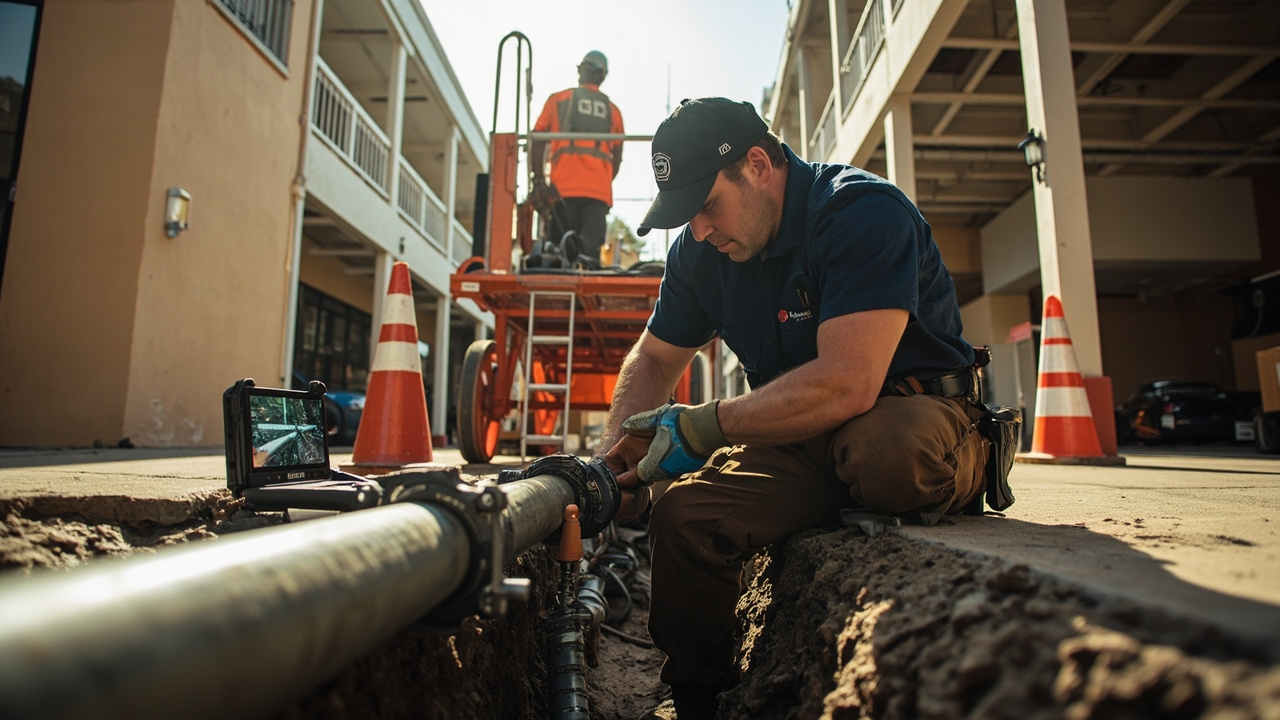
Commercial sewer repair services require different equipment, expertise, and planning than residential work. You cannot afford a crew that shows up with a residential snake for a 6-inch commercial main. Professional industrial sewer line repair begins with high-definition video camera inspection to map the entire system, identify failure points, and determine the most cost-effective repair strategy.

We deploy truck-mounted hydro jetting equipment capable of clearing commercial-grade blockages and removing years of scale buildup. For structural failures, we evaluate whether trenchless pipe bursting or targeted excavation makes sense for your site. Trenchless methods minimize surface disruption, which matters when you have parking lots, loading docks, or landscaping to protect. Excavation becomes necessary when pipes have collapsed completely or when surrounding soil contamination requires remediation.

Material selection matters. We do not replace failing clay pipe with more clay pipe. Modern commercial installations use Schedule 40 PVC or ductile iron depending on depth, load requirements, and soil conditions. Proper backfill and compaction prevent future settling. All work follows Los Angeles Municipal Code Chapter 6 plumbing standards and requires permits for any work in the public right-of-way.

The difference between a quick fix and a lasting repair comes down to understanding commercial load requirements. A restaurant generates different waste characteristics than a medical office. We size cleanouts appropriately, ensure adequate slope, and install access points that make future maintenance possible without destroying improvements. That is how you avoid repeat failures and protect your investment.

What Happens During Your Commercial Sewer Line Repair

Commercial Sewer Line Repair in Los Angeles – Minimize Downtime and Protect Your Business Operations
01

System Diagnosis and Planning

We start with video camera inspection of your entire commercial sewer system. This maps pipe condition, locates blockages, identifies root intrusion points, and documents any structural failures. You receive a detailed scope report with repair recommendations and permit requirements. For occupied buildings, we coordinate access times that minimize business disruption and plan temporary waste handling if needed.
02

Repair Execution and Compliance

Repair work proceeds using the method your situation requires. Trenchless pipe bursting pulls new pipe through the old line with minimal excavation. Traditional dig-and-replace becomes necessary for collapsed sections or when surrounding contamination requires soil remediation. All work follows permit requirements, includes proper shoring and safety protocols, and uses commercial-grade materials rated for your property's demands. We coordinate inspections and maintain site safety throughout.
03

Testing and Handoff

Before we close permits, your new sewer line undergoes pressure testing and final video inspection to confirm proper installation and flow. You receive documentation for your property records, including material specifications, depth measurements, and cleanout locations. We restore surfaces to match existing conditions and provide guidance on maintenance intervals that prevent future failures. Your system returns to full operational capacity with minimal lost business time.

Why Los Angeles Businesses Trust Our Commercial Sewer Repair Expertise

Commercial sewer work is not something you hand to the lowest bidder. The contractor you choose needs to understand Los Angeles building codes, coordinate with city inspectors, and complete work without shutting down your business for days. We have repaired sewer mains for restaurants in Koreatown, medical buildings in Century City, and industrial facilities throughout the greater Los Angeles metro. That experience matters when you need the job done right the first time.

We know which permits Los Angeles requires for different repair scenarios. Work in the public right-of-way triggers different requirements than on-property repairs. We handle permit applications, coordinate required inspections, and ensure compliance with Department of Building and Safety standards. You do not need to become an expert in municipal code. That is our responsibility.

Equipment capacity separates commercial contractors from residential plumbers. Our hydro jetting trucks deliver 3,500 PSI and handle 6-inch and 8-inch commercial mains. Our camera systems inspect lines up to 400 feet and generate reports you can share with property managers or use for insurance documentation. When excavation is required, we bring the equipment to complete the job efficiently, not stretch a three-day repair into two weeks.

Business continuity matters. We schedule work to minimize operational disruption, provide temporary waste solutions when needed, and communicate clearly about timelines and site access. You need a partner who understands that every hour of downtime costs you money. We treat your emergency as our priority and your timeline as a commitment we keep.

What to Expect from Your Commercial Sewer Line Repair Project

Response Time and Scheduling

Commercial sewer emergencies get priority response. We understand that a failed sewer main can force you to close your doors or violate health codes. Initial assessment typically happens within hours of your call. For planned repairs, we work around your business schedule. Restaurants get service during closed hours. Office buildings get work completed over weekends when possible. We provide realistic timelines before work begins and meet the deadlines we commit to. Emergency repairs that require immediate excavation begin the same day with temporary waste handling solutions to keep your facility operational.

Comprehensive System Assessment

Video camera inspection shows you exactly what we find. You see the root intrusion, the pipe collapse, or the grease buildup causing your problems. The inspection report documents pipe material, diameter, depth, and condition throughout your system. This prevents surprise discoveries mid-project and gives you the information needed for insurance claims or property disclosure. We identify not just the immediate failure but potential problem areas that could fail next. That allows you to plan proactive repairs and avoid future emergencies. The assessment includes recommendations for cleanout additions or system modifications that improve long-term reliability.

Quality of Completed Work

Your repaired sewer line meets or exceeds current Los Angeles building code requirements. New pipe installations use materials rated for commercial loads and Los Angeles soil conditions. All joints are properly sealed and tested. Excavated areas receive engineered backfill and compaction to prevent future settling. Surface restoration matches existing conditions, whether that means asphalt, concrete, or landscaping. You receive complete documentation including material specifications, depth measurements, and cleanout locations for your property records. Final inspection approval confirms the work meets municipal standards. Your system returns to reliable operation with increased capacity and longevity.

Ongoing Maintenance and Prevention

Commercial sewer systems require periodic maintenance to prevent failures. We provide specific recommendations based on your property type and usage patterns. High-grease operations like restaurants benefit from quarterly hydro jetting. Medical facilities and hotels need annual video inspections to catch problems early. We document maintenance intervals appropriate for your situation and offer scheduled service programs that prevent emergency failures. Proper maintenance extends system life and avoids the revenue loss that comes with unexpected closures. You receive maintenance records that satisfy property management requirements and provide documentation for future property transactions or refinancing.

Frequently Asked Questions

You Have Questions,
We Have Answers

Will insurance pay for sewer line replacement? +

Most commercial policies exclude gradual sewer line deterioration. Coverage typically applies only to sudden, accidental damage from a covered peril like vandalism or vehicle impact. If tree roots slowly cracked your line or aging cast iron corroded over time, expect denial. Review your policy's water and sewer backup endorsement. Some Los Angeles properties built pre-1980 face higher risk due to outdated Orangeburg or clay piping. Document the failure cause immediately. If a third party caused the break, their liability coverage may apply. Consult your broker before filing to avoid premium increases on denied claims.

How much does it cost to fix a collapsed sewer line? +

Collapse repairs depend on depth, access, and business disruption costs. Excavation in Los Angeles often encounters compacted soil and requires street permits, adding expense. Expect costs to escalate if your line runs under structures or conflicts with municipal infrastructure. Trenchless methods reduce surface restoration but require specialized equipment. Factor in code upgrades, Los Angeles mandates compliance with current plumbing standards during major repairs, which may require upsizing or rerouting. Lost revenue during downtime often exceeds repair costs for restaurants and medical facilities. Get multiple scoped bids, camera inspection results dictate the most cost-effective approach.

Can sewer pipes be repaired without digging? +

Trenchless methods like pipe bursting and cured-in-place pipe lining eliminate excavation in many scenarios. CIPP works for pipes with structural integrity and minimal offset joints. Pipe bursting replaces collapsed lines by fracturing the old pipe and pulling new HDPE through the path. Both methods minimize surface disruption, critical for Los Angeles businesses with landscaping or paved areas. Limitations exist. Severe collapses, bellied sections, or pipes under building footings may still require excavation. A camera inspection determines candidacy. Trenchless typically costs more per linear foot but reduces restoration expenses and keeps your operation running.

Is relining sewer pipe worth it? +

Relining extends service life 50 years when the host pipe retains structural shape. For Los Angeles commercial properties facing minimal excavation access or historic building restrictions, relining prevents costly surface restoration. The epoxy liner bonds to the interior, sealing cracks and stopping root intrusion. Relining reduces pipe diameter slightly, verify your flow capacity meets current demand. It fails cost analysis if the existing pipe has collapsed sections or severe misalignment. Relining works best for proactive maintenance before catastrophic failure. Compare the cost against full replacement, including permit fees, surface restoration, and business interruption. ROI depends on your specific site conditions.

Who is responsible for a broken sewer pipe? +

Responsibility splits at the property line in Los Angeles. Commercial property owners maintain all private lateral lines from the building to the municipal connection point, typically under the street or alley. The city owns and repairs the main sewer line. Confusion arises where the lateral connects to the main. If tree roots from your property damage the city main, you may face liability. Shared laterals in multi-tenant buildings require clear maintenance agreements. Review your lease or CC&Rs. During a backup, determine the blockage location immediately. City crews will camera their section, you pay for private lateral issues.

What is the average lifespan of a sewer line? +

Cast iron lasts 50 to 75 years before corrosion causes failure. Clay pipe ranges from 50 to 100 years but cracks under ground shifting common in Los Angeles due to seismic activity. PVC and HDPE installed since the 1980s can exceed 100 years with proper bedding. Orangeburg fiber pipe, common in post-war construction, fails within 30 to 50 years. Lifespan depends on soil chemistry, root intrusion, and flow characteristics. Acidic waste from certain industries accelerates corrosion. Schedule camera inspections every five years for lines older than 40 years. Proactive relining or replacement prevents emergency failures and compliance violations.

Why is sewer line replacement so expensive? +

Excavation depth drives costs in Los Angeles, commercial lines often run six to ten feet below grade. Street permits, traffic control, and shoring requirements add expense. You pay for compliant backfill, compaction testing, and surface restoration to city standards. Asphalt replacement costs more than you expect. Code upgrades are mandatory, older systems require cleanouts, proper slope, and potentially upsized pipe. Trenchless methods carry high equipment costs but reduce restoration expenses. Unexpected conditions like groundwater, conflicting utilities, or contaminated soil trigger change orders. Business continuity measures, temporary sewage handling, after-hours work, increase total project costs significantly.

Does insurance cover broken pipe under the slab? +

Policies vary widely on sub-slab coverage. Standard commercial property insurance excludes wear and deterioration. If a sudden pipe burst causes water damage, the resulting damage to property may be covered, but not the pipe repair itself. Slab leak endorsements exist but require separate purchase. Los Angeles properties with post-tension slab construction face higher repair costs due to cutting restrictions. Review your policy's exclusions for earth movement, if shifting soil broke the pipe, you likely have no coverage. Service line coverage endorsements protect the pipe itself but cap reimbursement low. Read your policy before assuming coverage exists.

How much to sleeve a sewer line? +

Sleeving, or CIPP relining, typically costs less than full excavation but more per linear foot than open trench in simple scenarios. Price depends on pipe diameter, length, access points, and required cure method. Los Angeles projects require permits and inspection, adding flat fees. Expect higher costs for lines under structures or requiring bypass pumping during installation. The trade-off is minimal surface disruption and faster completion. Get a camera inspection first, the report shows whether your pipe qualifies for sleeving. Severe damage requires excavation. Compare total project costs, including restoration and lost business time, not just installation rates.

What is the cheapest way to replace a sewer line? +

Open trench excavation offers the lowest per-foot installation cost when you have direct access and minimal restoration requirements. For Los Angeles commercial sites, this rarely applies. Factor in permit fees, traffic control, asphalt replacement, and compaction testing. Phased replacement spreads costs but extends disruption. Spot repairs address immediate failures but leave aging pipe intact, risking repeat failures. Trenchless methods cost more upfront but eliminate expensive surface restoration. The true cheapest method balances immediate repair costs against business downtime and future failure risk. Camera inspect the entire line, replace comprehensively rather than repeatedly patching failures over years.

How Los Angeles Seismic Activity and Aging Infrastructure Impact Commercial Sewer Systems

Los Angeles sits on multiple fault systems that create ground movement commercial sewer lines must withstand. The 1994 Northridge earthquake damaged thousands of sewer laterals and mains. Even minor seismic events cause soil shifting that stresses rigid pipe materials. Properties built before 1980 often have cast iron or clay pipe that lacks the flexibility to handle ground movement. These older systems develop cracks, joint separation, and misalignment that worsens over time. Combined with Los Angeles's mature tree canopy, particularly the aggressive root systems of ficus and eucalyptus common in commercial landscaping, you face constant pressure on underground infrastructure. Commercial sewer main repair in Los Angeles requires understanding these unique stress factors and using materials and installation methods that account for ongoing ground movement and biological intrusion.

Los Angeles County maintains strict requirements for commercial sewer work. Any repair affecting the public sewer main requires coordination with the Bureau of Sanitation. Work in the public right-of-way triggers encroachment permits and traffic control plans. Health permits come into play for food service and medical facilities. Choosing a contractor familiar with these requirements prevents project delays and failed inspections. We maintain relationships with Los Angeles city inspectors and understand the documentation they expect. That local knowledge keeps your project moving forward and ensures you pass inspection the first time. For business owners, that familiarity with local processes is the difference between a three-day repair and a three-week ordeal that bleeds revenue.
Plumbing Services in The Los Angeles Area

Discover where we operate and easily locate our office or service areas on the map below. Whether you're planning routine maintenance or dealing with an urgent plumbing issue, you’ll see we’re right in your neighborhood. Use the interactive map to view service zones, our central office location, and nearby landmarks. You can zoom in for detailed directions or get contact info directly—with just a click, get directions to meet our skilled plumbing team in person.

Address:
A Plus Plumbing Los Angeles, 6080 Center Dr, Los Angeles, CA, 90045

Additional Services We Offer

Our news updates

Latest Articles & News from The Blogs

Everything You Need to Know About Sewer Connections for a Valley Village ADU Adding an accessory dwelling unit to your…

Everything You Need to Know About Sewer Connections for a Valley Village ADU

Everything You Need to Know About Sewer Connections for a Valley Village ADU Adding an accessory dwelling unit to your…

How to Get Rid of That Sulfur Smell in Your Van Nuys Water Heater

How to Get Rid of That Sulfur Smell in Your Van Nuys Water Heater \p>If your hot water smells like…

Why Replacing Plastic Supply Lines With Braided Stainless Steel Can Save Your Toluca Lake Home From Water Damage

Why Replacing Plastic Supply Lines With Braided Stainless Steel Can Save Your Toluca Lake Home From Water Damage Water damage…

Contact Us

Every day you wait increases your risk of complete system failure and forced closure. Get a professional assessment of your commercial sewer system now. Call A Plus Plumbing Los Angeles at (213) 449-7577 for same-day inspection and repair estimates that protect your business continuity.